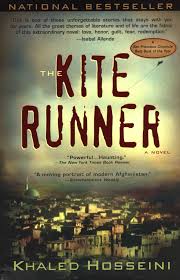
 The Kite Runner evoked some of my happiest and saddest feelings with the story of a young boy named Amir who was searching for ways to earn the respect of his father. Amir struggles with standing up for himself along with searching for a way to repent the sins he created as a child.
The beginning of the book explains how Amir felt about Hassan and how his father Baba became the man he was however, it took me a while to actually become interested in the story. I felt as though the first hundred pages or so became somewhat repetitive when all it seemed to do was explain the faults and fears Amir had over and over again. For a long time it never even scratched the surface of how the main character was going to overcome his faults. Of course though the main character does overcome his greatest fears but I thought the author took much to long to actually get to that point.
The book started to get interesting when Amir and Baba ended up in America when Amir starts to bury his past however Baba seeks to regain it. The contrast of the two characters played an interesting part because their differences actually brought them together little by little. In Afghanistan Baba was the character who continuously seemed to be on the rise however when they escaped to America the tables turned and Amir began to grow. I finally started to really enjoy the piece when this occurred since it brought out the change in Amir that I had been waiting for the entire novel.
Nearing the end when Amir travels back to Kabul I believe the book took a dramatic change that encompassed the reader's innermost feelings. The author utilizes Amir's life long struggle to finally bring him back to Afghanistan so he may finally face his fears and his faults head on. What I enjoyed about this section is that Amir comes back thinking he will repay Hassan by easily finding his son and placing him in a safe orphanage however instead he ends up repaying himself as well while enduring torture and intense pain.
Overall, I thought the Kite Runner was a fascinating story and although it took awhile to get to the point, it was worth it because the point it lead to was so strong and life changing and that made up for the slower parts of the book.
The Kite Runner evoked some of my happiest and saddest feelings with the story of a young boy named Amir who was searching for ways to earn the respect of his father. Amir struggles with standing up for himself along with searching for a way to repent the sins he created as a child.
The beginning of the book explains how Amir felt about Hassan and how his father Baba became the man he was however, it took me a while to actually become interested in the story. I felt as though the first hundred pages or so became somewhat repetitive when all it seemed to do was explain the faults and fears Amir had over and over again. For a long time it never even scratched the surface of how the main character was going to overcome his faults. Of course though the main character does overcome his greatest fears but I thought the author took much to long to actually get to that point.
The book started to get interesting when Amir and Baba ended up in America when Amir starts to bury his past however Baba seeks to regain it. The contrast of the two characters played an interesting part because their differences actually brought them together little by little. In Afghanistan Baba was the character who continuously seemed to be on the rise however when they escaped to America the tables turned and Amir began to grow. I finally started to really enjoy the piece when this occurred since it brought out the change in Amir that I had been waiting for the entire novel.
Nearing the end when Amir travels back to Kabul I believe the book took a dramatic change that encompassed the reader's innermost feelings. The author utilizes Amir's life long struggle to finally bring him back to Afghanistan so he may finally face his fears and his faults head on. What I enjoyed about this section is that Amir comes back thinking he will repay Hassan by easily finding his son and placing him in a safe orphanage however instead he ends up repaying himself as well while enduring torture and intense pain.
Overall, I thought the Kite Runner was a fascinating story and although it took awhile to get to the point, it was worth it because the point it lead to was so strong and life changing and that made up for the slower parts of the book.
1. It is Amir's dearest wish to please his father. What fuels this wish? To what extent does he succeed in doing so and at what cost? What kind of man is Baba? How would you describe his relationship with Amir and with Hassan? How does that relationship change, and what prompts those changes?
2. After Soraya tells Amir about her past, she says, "I'm so lucky to have found you. You're so different from every Afghan guy I've met." (page 157) How do Afghan women fare in America? Are they any better off than they were in Afghanistan before the Taliban seized power? There is a noticeable absence of women in the novel. How is this significant?
3. On the drive to Kabul Farid says to Amir "You've always been a tourist here, you just didn't know it." (page 204) What is Farid implying? What do you think of his implication? What gives a person worth in a society? Does this vary between societies?
4. What is Amir's relationship with Baba in the beginning of the book? How does it change after he wins the kite fighting tournament?
5. America acts as a place for Amir to rehash his memories and as a place for Baba to mourn his. In America, there are "homes that made Baba's house in Wazir Akbar Khan look like a servant's hut." (page 135) What is ironic about this statement? What is the function of irony in this novel?
6. Baba and Amir know that they are very different people. Often it disappoints both of them that Amir is not the son that Baba has hoped for. When Amir finds out that Baba has lied to him about Hassan, he realizes that "as it turned out, Baba and I were more alike than I'd ever known." (page 226) How does this make Amir feel about his father? How is this both a negative and positive realization?
“There is only one sin. and that is theft... when you tell a lie, you steal someones right to the truth.”
“it always hurts more to have and lose than to not have in the first place.”
“She said, 'I'm so afraid.' And I said, 'why?,' and she said, 'Because I'm so profoundly happy, Dr. Rasul. Happiness like this is frightening.' I asked her why and she said, 'They only let you be this happy if they're preparing to take something from you.”
“Not a word passes between us, not because we have nothing to say, but because we don't have to say anything”
“One time, when I was very little, I climbed a tree and ate these green, sour apples. My stomach swelled and became hard like a drum, it hurt a lot. Mother said that if I'd just waited for the apples to ripen, I wouldn't have become sick. So now, whenever I really want something, I try to remember what she said about the apples.”
“Attention shifted to him like sunflowers turning to the sun.”
“Children aren't your colouring books. You Don't get to fill them with your favourite colours”
“The desert weed lives on, but the flower of spring blooms and wilts.”
“America was different. America was a river, roarng along, unmindful of the past. I could wade into this river, let my sins drown to the bottom, let the waters carry me someplace far. Someplace with no ghosts, no memories, and no sins.”
“Ali and Baba grew up together as childhood playmates- at least until polio crippled Ali’s leg- just like Hassan and I grew up a generation later. Baba was always telling us about the mischief he and Ali used to cause, and Ali would shake his head and say, “But, Agha Sahib, tell them who was the architect of the mischief and who the poor laborer?” Baba would laugh and throw his arm around Ali.
But in none of his stories did Baba ever refer to Ali as his friend.
The curious thing was, I never thought of Hassan and me as friends either. Not in the usual sense, anyhow. Never mind that we taught each other to ride a bicycle with no hands, or to build a fully functional homemade camera out of a cardboard box. Never mind that to me, the face of Afghanistan is that of a boy with a thin-boned frame, a shaved head, and low-set ears, a boy with a Chinese doll face perpetually lit by a harelipped smile.
Never mind any of those things. Because history isn’t easy to overcome. Neither is religion. In the end, I was a Pashtun and he was a Hazara, I was a Sunni and he was a Shi’a, and nothing was ever going to change that. Nothing." (pg 25)
Using Marks: In the passage above I placed question marks around the areas that I thought were either confusing or might have had a double meaning in order to realize the places that confused me or could make me see the writing in a different way the second time around. For example, when it brings up polio crippling Ali's leg, I wondered if it had a double meaning of the separation between the families and maybe even the superiority between Baba and Ali or even Amir and Hassan.
Marginal Comments: Instead of writing directly in the book which seemed to be a problem for me, I used sticky notes to write a short summary of certain pages on them. For this specific page I wrote about how the passage was meaningful because Amir was looking back on his memories about Hassan and also his father. I thought it effectively showed the separation between Amir and Hassan. It also showed the importance of class and religions in Afghanistan. This passage was important to the book because the story revolves around Amir and Hassan's friendship and this passage showed Amirs view of his "friendship" with Hassan.
Highlight, bracket, or underline the text: This was easy to do because it allowed me to underline my favorite quotes and passages however I would assume it would be difficult to do this in a book you don't actually own such as a library book. However, in this passage I highlighted, But in none of his stories did Baba ever refer to Ali as his friend. I chose that specific sentence because it was true in not only Baba's relationship but also Amir's which I found interesting because then why did Baba believe Hassan was such an important part of his life? Of course later on the truth was revealed.
Circle Words: Luckily Khaled Hosseini's diction wasn't too sophisticated making it irrelevant to circle many words however in the instances when he used words from his own language without translating them, that was when I circled words and had to look further into it.
Overall there were a lot of different aspects to annotating a piece however the four tools above seemed to be the most important or at least the most straight-forward ways to annotate.


.JPG)


